For Hollow Glen residents, chemin Kelly is one of the sector's main routes. Built several decades ago, the road has reached the end of its lifecyle and now needs major reconstruction work. The torrential rains of August 9, 2024 only accelerated the deterioration of the road surface and further compromised its drainage and the stability of its foundation. The surge of water did more than damage the surface of the road — it also disrupted the drainage around it: ditches deformed, runoff diverted, culverts submerged or blocked. Since then, water no longer leaves the right-of-way as it should.
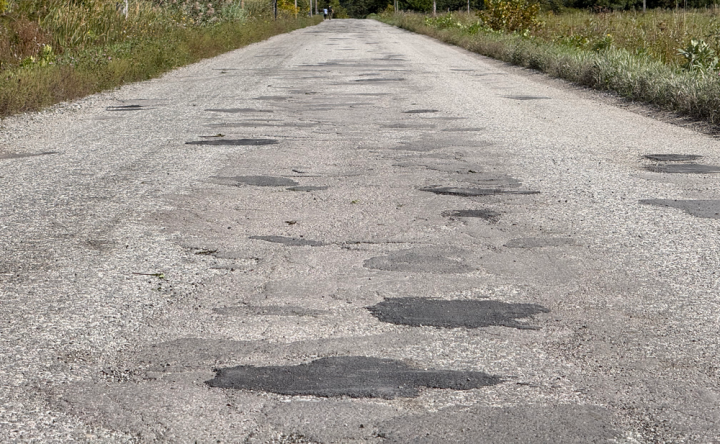
Instead of draining away, the water saturated the road's foundation — the layer of material the asphalt sits on. Ground that stays saturated loses its ability to carry a load: it heaves when it freezes, settles when it thaws, and shifts under passing vehicles.
Anyone who drives chemin Kelly daily watches the same spots break down, year after year. It is also why spot repairs no longer hold. As long as the ground underneath keeps moving, new asphalt cracks within months. With the road surface at the end of its useful life and the foundation affected, the drainage, the foundation and the surface all have to be dealt with.
The planned work
Restoring chemin Kelly to a durable condition will require:
- Drainage work: reprofiling the ditches and replacing certain culverts. This is the core of the project. Giving water a clear path out of the right-of-way is what keeps the ground under the road from staying saturated.
- Localized foundation work. Where the foundation is particularly damaged or unstable, it will have to be rebuilt rather than simply covered over.
- Road surface reconstruction. The new surface comes last, once the drainage and foundation work is complete.
The work has to be done in that order for the investment in the road surface to last.
Who owns the road — and why that delayed planning
The first delay came down to a question with no obvious answer: ownership of chemin Kelly was not clearly established at the outset.
Before the work could be planned, funding sought, or the necessary administrative steps taken, it had to be determined who owned this infrastructure and which municipality was responsible for it.
Verification confirmed that chemin Kelly belongs to the City of Gatineau, even though it directly serves the Hollow Glen sector and is used daily by Chelsea residents. That clarification allowed the Municipality to move forward with the City of Gatineau and to bring a loan by-law to Council — which was done this summer.
Why the work will not go ahead this year
A section of chemin Kelly falls within protected wildlife habitat.
Every municipal project has to be reviewed against the new mapping of protected wildlife habitat, which is binding on us. That review found that a portion of chemin Kelly is covered by the mapping. Until the situation is resolved with the Québec government, the Municipality cannot authorize work in that area.
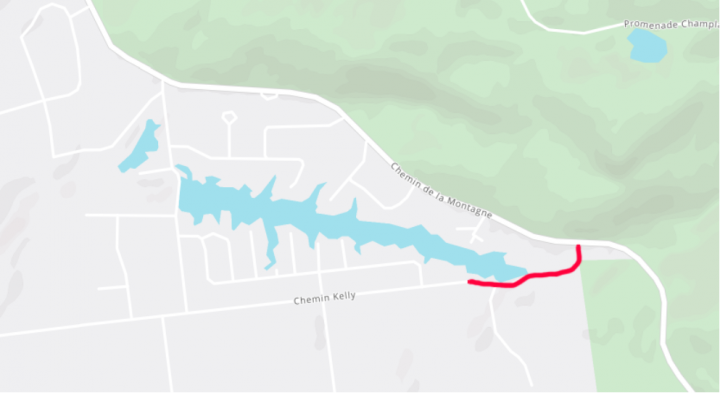
In red, the section of chemin Kelly located in protected wildlife habitat.
We recognize that this situation is an inconvenience for residents, all the more so on a road that has been in poor condition for two years. A number of people have been in the same position with their own projects since this mapping came into force. The Municipality applies the same rule to its own projects as it does to everyone else's.
This file remains a priority for the administration in its dealings with the Québec government and the MRC des Collines-de-l'Outaouais.
The financing
On July 14, 2026, Council adopted by-law no. 1392-26, decreeing capital expenditures and a loan of $2,425,800 to finance the reconstruction of chemin Kelly. Under an intermunicipal agreement, the City of Gatineau will cover 50% of eligible costs, up to a maximum of $700,000. That contribution will reduce the share of the costs borne by the Municipality of Chelsea by the same amount. Discussions have been held with Gatineau to defer the contribution to 2027, and the response is positive.
Most of the work will also be carried out in-house by our Public Works team, which represents a significant saving on the cost of the project.
Next steps
Several steps remain before the work can begin:
- Resolving the protected wildlife habitat question with the Québec government, for the portion of the road covered by the mapping.
- Approval of the loan by-law. A municipal loan of this size must be authorized by the Québec government before the expenditures can be committed.
- Obtaining the necessary authorizations and permits, in particular for work on the drainage and the culverts.
- Preparing the plans and specifications and, for the portions requiring outside expertise, a public call for tenders.
On the timeline currently envisaged, the work cannot begin before the spring of 2027. The project remains in the three-year capital works program and will be treated as a priority by Public Works in 2027.
The detailed schedule — work dates, sections affected, traffic restrictions and detours — will be published as soon as planning is far enough along.
In the meantime
With the road at the end of its useful life, some deterioration may continue to worsen before the work is carried out. Our Public Works team will nonetheless continue routine maintenance and monitoring of the road's safety.
If you notice sudden deterioration, significant slumping, or a drainage problem, submit a report under "Roads, signage, ditches, lighting" on Chelsea's citizen portal, pivot.chelsea.ca.
This page was last updated on September 16, 2026
