Drinking Water Treatment Plant: Concrete Measures to Improve Service
June 2, 2026
The Municipality is implementing its action plan to reduce the frequency of boil water advisories that inconvenience residents and to address the growing pressure on the drinking water treatment plant. After nearly 10 years of operation and significant growth in the number of homes in the village core, the current facilities are reaching their limits and must be adapted to better serve residents.
In recent years, the Municipality has deployed several measures to maximize production capacity. Improvements have been made to filtration systems, equipment, and pumps, in addition to strengthening the operations team. A bylaw governing the use of drinking water has also been introduced to promote responsible consumption.
This year, the Municipality is continuing to enhance service with the implementation of an alarm management system to improve response times and reduce the risk of incidents. A comprehensive study on the plant’s remaining capacity is also underway to better target solutions.
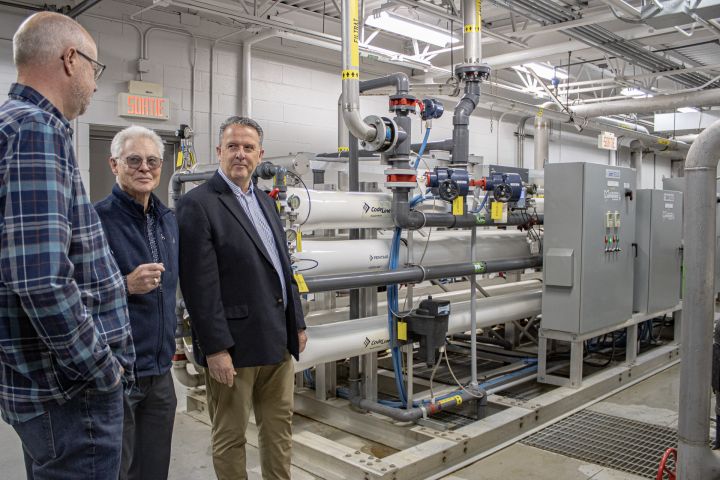
Dominic Labrie, Councillor of Ward 2, Donald Déry, Councillor of Ward 6, and Mayor Brian Nolan, on a visit to the drinking water treatment plant.
To address longer-term challenges, the municipal council has included the modernization of the drinking water treatment plant in its 2026–2030 Five-Year Capital Expenditure Program. An amount of $603,000 has been allocated this year for analysis and design work, and $5,000,000 in 2027 for construction. The project includes, among other things, the addition of new treatment stages, the upgrading or replacement of existing equipment, and an increase in overall production capacity.
These measures are aimed directly at stabilizing drinking water production, reducing pressure drops, and decreasing the frequency of boil water advisories. At the same time, procedures and tools have been improved to speed up water testing and optimize the management of preventative situations.
The project will be carried out in several phases, including scenario analysis, design, and construction. An extension of the current moratorium will be required to protect system capacity during this period.
Finally, project funding will be distributed equitably: expansion work will be financed through development charges tied to new construction projects, while costs related to clogging issues and operations will be borne primarily by users currently connected to the system.
This page was last updated on June 2, 2026
