
Injured, sick or dead wild animal
- Report an injured, sick or dead wild animal
- Aide animale Québec (AAQ) : Emergency – Aide Animale Québec
Mandatory reporting / Poaching / Illegal acts
To report an animal subject to mandatory reporting (injured or dead) or an illegal act (poaching, illegal traps, harassment, etc.).
- SOS Braconnage – Wildlife Emergency: 1-800-463-2191
Living with Wildlife
A wild animal is an animal that lives in nature and survives on its own, without human help.
To promote coexistence with wildlife, the Municipality offers tips and tricks on:
THE BEAVER
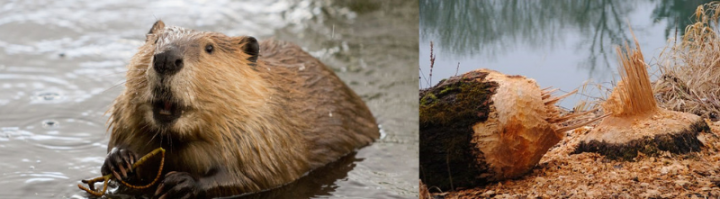
Responsibilities of waterfront property owners
Under Regulation 152-10 of the MRC des Collines-de-l’Outaouais, property owners are responsible for the free flow of water in watercourses that cross their land. Beaver activity can alter or slow this flow, so owners must monitor the situation and put control methods in place as needed.
Property owners can consult the Practical Guide to the Free Flow of Water in Watercourses of the MRC des Collines-de-l’Outaouais, as well as Regulation 152-10.
Tips and tricks
It is best to plant only native species that are not very attractive to beavers:
- Sweet gale (Myrica gale)
- Bog-rosemary (Andromeda glaucophylla)
- Bog Labrador Tea (Ledum groenlandicum)
- Sweet fern (Comptonia peregrina)
- Large flowered Spirea (Spirea grandifolia)
- Juniper (Larix laricina)
- Cedar (Thuja occidentalis)
- Eastern hemlock (Tsuga canadensis)
- Balsam fir (Abies balsamea)
- Spruce sp. (Picea sp.)
- Pine sp. (Pinus sp.)
- Canadian yew (Taxus canadensis)
- Quaking aspen (Populus tremuloides)
- Willow sp. (Salix sp.)
- Alder sp. (Alnus sp.)
- Roses, cherries, dogwood, serviceberry, rowan, etc. (fruit shrubs)
A well-vegetated riparian buffer makes beaver access points less inviting and harder to cross. The beaver then has to work harder to drag wood than it would on a riparian buffer of lawn.
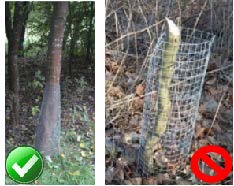
It is recommended to install galvanized metal wire mesh with openings of no more than 5 cm. The mesh must be at least one metre high so that the beaver cannot gnaw the tree above it.
Habitat
The beaver builds a dam and a lodge (home) by felling trees near the body of water where it lives. The dam creates a pond deep enough not to freeze, which lets the beaver stay active all winter. The lodge includes a resting area, a feeding area, a source of fresh air and generally two exits.
Diet
In winter, the beaver feeds on its stockpile of branches and bark. In summer, it eats roots, aquatic plant stems and herbaceous plants.
Reproduction
Beavers mate for life. The kits are born in May or June, after a gestation of about 100 days. They stay with their parents for 2 to 3 years, then leave to find a mate and a habitat where they can build their own lodge and dam.
THE BLACK BEARS
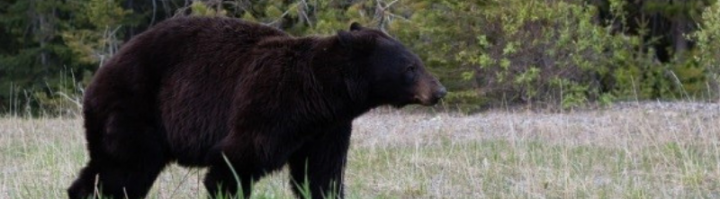
Good to know
- Some human activities attract bears and can draw them out of the forest.
- Bears remember the location of food sources very well.
- In general, bears fear humans and very rarely become aggressive.
General information
In summer, bears need a lot of food to build up fat reserves before winter. Table scraps and well-stocked bird feeders are a concentrated, energy-rich food source. Thanks to its highly developed sense of smell, the bear easily locates food. If food is easy to get, the bear will get used to it, at the risk of its own safety and that of people.
Tips and tricks when a bear is regularly present on a property
If the smell of garbage is attracting the bear, a small amount of dolomitic lime can be applied in bags and containers, which should also be washed regularly. It is also strongly recommended to put garbage out on the day of collection. In the meantime, it can be stored in bear-proof containers or in an enclosed area.
If a feeder is attracting the bear, it can be moved to an inaccessible spot, for example hung from a tree. It can also be replaced with bird baths and a variety of flowers, which are just as effective at attracting birds to the yard. It is best not to feed birds between April and November to avoid trouble with bears.
Barbecue grills should be cleaned regularly to limit odours. Any food that has fallen to the bottom must be fully cooked. The barbecue is best placed out of the prevailing winds, then stored under a cover or in the shed.
A well-made compost does not give off odours. Whole fruit should not be put in the composter in areas where bears are common. Fruit from fruit trees should be picked as soon as it ripens, and fallen fruit should be gathered up. Finally, pet food should be kept somewhere bears cannot reach.
If the bear is still prowling after these measures, a wildlife conservation officer can assess the situation and suggest solutions.
A threatening bear, or one that is causing property damage, may be killed only if every means of scaring it away or preventing it from causing damage has been taken (sections 67 and 68 of the Act respecting the conservation and development of wildlife).
Need information?
Information is available on the gouvernement du Québec (French only).
In an emergency, the following resources are available:
- S.O.S Braconnage (poaching hotline): 1-800 463-2191 (open day and night)
- Wildlife Protection: 819 246-1910 (weekdays)
- National Capital Commission (NCC): 819 239-5353, if the bear is inside Gatineau Park
THE TICK
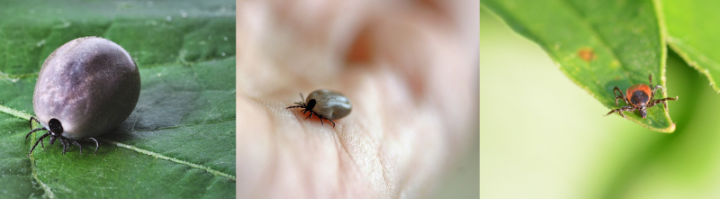
The deer tick (Ixodes scapularis) is an arachnid found in the Outaouais. It can bite warm-blooded animals, including humans, and transmit certain diseases, such as Lyme disease.
Several ticks in Chelsea have been confirmed to carry this disease. It is therefore important for the public to learn to recognize the deer tick, take precautions before and after outdoor activities, and know what to do in the event of a bite.
The deer tick is an arachnid (not an insect). It can be recognized by its black head and legs, and its reddish-brown back and abdomen. It measures 1 to 3 mm. When the female is engorged with blood, its volume can triple and its colour becomes bluish-grey, which makes it easier to spot.
- Wear a hat, long light-coloured clothing and closed shoes when heading out into nature.
- Tuck your shirt into your pants and your pant legs into your socks or boots.
- Apply an insect repellent containing DEET.
- Check your body, as well as your children’s and pets’ bodies, after an outing in nature.
- Examine your equipment to avoid bringing ticks into the home.
- Put clothing in the washer (hot water, at least 40 minutes) or in the dryer (high heat, at least 60 minutes) to eliminate ticks.
- Take a shower and examine your body.
For Lyme disease to be transmitted, the tick must be infected with the bacterium Borrelia burgdorferi. The risk is very low if the tick stays attached to the skin for less than 24 hours, but it increases over time. It is therefore important to remove it as quickly as possible.
-
Remove the tick by following the protocol of the CISSS de l’Outaouais.
-
Place the tick in an airtight container.
-
Note the date and location of the bite.
-
Call Info-Santé at 811.
-
See a doctor or clinic if you develop symptoms of Lyme disease within 3 to 30 days after the bite.
Consult the CISSS de l'Outaouais's information about Lyme disease
For information
Environment Department
This page was last updated on November 25, 2026
